news…Si e’ proprio cosi’ aprire una societa’ nel Delaware conviene ,la giurisdizione più economica presente in tutto il mondo dove costituire una società.
Particolarmente di notevole interesse soprattutto se non si intende fare trading, affari, negli Stati Uniti. Infatti, secondo la legge del Delaware non c’e’ nessuna imposta sugli utili a carico della società se questa soddisfa rispetta le seguenti condizioni:
-la società non svolge nessuna forma di business/attivita’ nel territorio statunitense e non deve avere conti correnti nel territorio ameriacano -i soci devono essere tutti stranieri residenti all’estero
-la società non possiede conti correnti bancari in U.S.A.
con questa fattibilita’ la LLC non paga nessuna imposta/tasse sugli utili conseguti fatta eccezione per una imposta unica a forfait di 200/250 dollari americani in forma annuale.
Altre utili indicazioni:
Numero minimo di soci è 1, senza distinzione nè di nazionalità nè di residenza.
Azioni sono nominative e non al portatore e i soci vanno indicati in fase di registrazione della società.
Anonimato, i soci (members) non compariranno in alcun elenco e registro ufficiale e saranno, difatto, anonimi. Gli azionisti non residenti sono esentati dalla tassa di ritenuta sui dividendi.
Solitamente queste società vengono costituite per eseguire operazioni in Europa.
Le Limited Liability Company per la loro elasticita’, e con una procedura semplice burocratica e soprattutto per l´anonimato che garantisce ai propri azionisti sono ideali per qualsiasi tipo di business nel campo dei servizi e prestazioni di ogni genere….consulenza, immobiliare, trust…
source: Offshore-Complete.com www.offshore-complete.com
duminică, 9 septembrie 2012

No vote, no tax - the Suffragettes and their tax protest
Drawing a straight line from the fussy and oppressive finery of late Victorian women’s fashion, to the racey, straight lines of the 1920s ‘flapper’ describes a surprisingly short period in history. In between these two incarnations of feminine style, stands the original ‘wild child’ of the early 20th century. Called ‘the Shrieking Sisterhood’, these hysterical suffragettes were mad, bad and dangerous to know. So much for historical stereotypes.
While some suffragettes chalked lines on pavements and wielded hammers and stones to smash windows in the streets, others were just as busy using hammers to barricade themselves in their homes. The lock-in became a means of protest against the obvious injustice of women being locked out of national politics. It is still profoundly shocking to realise that less than 100 years ago, it was illegal for women to take part in a British Parliamentary election. It was only in 1928 that women were finally granted voting rights equal to men.
Over twenty years before this, in 1906, the Liberals were swept into government by a landslide, helped in no small part by an army of women volunteer organisers. It was not until their second term in government, led by Asquith and Lloyd George, that the Liberals began to introduce a completely new system of taxation, including introducing National Insurance to try to provide some form of pension provision for ordinary workers. This provided the back-drop for one type of lesser-known protest, which aimed to pressure the government into granting votes to women.
Women householders were expected to pay their Imperial taxes, but were not considered full citizens of the state. The injustice was most obvious and often felt most keenly by wealthy, well-educated women landowners. Some of these voteless women were increasingly affronted by the fact that many of the male farm workers on their estates could vote, thanks to the electoral reform of the 1880s. The inconsistency of the situation was heightened by the fact that women householders had been granted municipal voting powers since 1869.
There were a few women tax resisters during the late Victorian period. It was not until the advent of a wider campaign for women’s suffrage, however, that the tax protest began to gain more momentum. It was perhaps afforded some legitimacy by an earlier campaign of ‘passive resistance’ to taxation conducted by Nonconformists against the Education Act of 1902. Thousands of church ministers and chapel-goers refused to pay church rates over an extended period. A few even went to prison over this matter of conscience. However, perhaps due to its sectarian nature, the protest failed to capture the public imagination or national headlines.
Given their association with the increasingly bitter struggle of the suffragettes, women tax resisters gained some notoriety, especially those whose protests ended in prison terms. The six week seige of Dora Montefiore’s home in 1906 London was widely reported at the time. Other tax resisters began to gather under the banner of the Women’s Tax Resistance League, formed in 1909. These women, many of them steeped in English history, drew their inspiration from a figure who at that time towered alongside Oliver Cromwell in the national consciousness: John Hampden. Hampden, an MP for the Aylesbury area, was seen as a Buckinghamshire hero for having refused to pay the ‘Ship Money’ of King Charles I. Several other Buckinghamshire people, including four women, also added their names to the initial protest.

It was this stand against what John Hampden saw as an unconstitutional tax, which drew Mrs Emmeline Pethwick-Lawrence to visit the Hampden monument at Chalgrove in 1910. Following the visit, the Women’s Social and Political Union also adopted tax resistance as one of its recognised means of protest. Their slogans included the war-cry of the American Rebels: ‘No taxation without representation’ and the more direct declaration: ‘NO VOTE, NO TAX’. Mrs Lawrence commented, "Just as John Hampden offered first passive resistance to authority and then active resistance, so the women had their course clearly marked out before them" (‘Votes for Women, Oct 7th 1910, p.4).
By July 1910 the WTRL boasted over 100 members, all of whom enlisted as being willing to take up this form of protest. However, a two-tier approach was adopted, which meant that some took action immediately, while others declared they were willing to become tax protesters once the total number of members reached 500. However, the total never exceeded 200 and even by 1911 there were still only 40 women actively making tax protests, according to Miss Raleigh of Uxbridge
Another was a resident of the town of Wendover in Buckinghamshire, Mrs Hamilton. Two years running, some of her goods were distrained and sold at the Red Lion pub in the centre of the town, where a meeting was then held to explain Mrs Hamilton’s reasons for resisting her Imperial taxes. Her arguments must have been persuasive for some. A local man, quoted in Mrs Hamilton’s Women’s Freedom League obituary, was reported to have said, "If ever there was a rebellion in the quiet village of Bucks, it was that day".
More impressive still was the Mrs Hamilton’s arguments seem to have won over the local tax collector himself, Mr Frederick Mead, who at a suffrage meeting in Aylesbury in November 1911, declared that he was in favour of women who had the municipal vote also gaining a vote for Parliament. Of course, his wife, who was active in hosting suffrage meetings herself, may have also played a part in persuading him!
The Women’s Tax Resistance League was particularly active in John Ha mpden’s own county (the photo here shows the sign outside Saint Nicholas' church, in Great Kimble, close to Hampden's family roots) . In 1912 they organised a march to Aylesbury prison, to protest at the forced feeding of hunger-striking suffragettes held there. There were riotous scenes in the market square afterwards, with suffragette speakers being drowned out and roughly treated by elements in the crowd. Sylvia Pankhurst arrived to speak in the town the next day but suffragettes were refused permission for a public meeting by the town council.
Later that year, women tax resisters and their supporters were grudgingly allowed to lay a wreath at the unveiling of the statue of John Hampden in the market square. The wreath bore the names of the four original women tax resisters: Mrs Westall and Widows Bampton, Goodchild and Semple. The suffragettes reportedly handed out two thousand leaflets on the day and sold 200 copies of a booklet about John Hampden, written by Mrs Darent Harrison. Mrs Harrison was to be beseiged in her own home in Hastings the following year, after she refused to pay her taxes and also blocked attempts to have her goods distrained (see here).
Find out more about the suffrage protesters of Buckinghamshire, by pre-ordering the book: ‘Burning to get the Vote - The Women's Suffrage Movement in central Buckinghamshire (1904 - 1914)’. This is due for publication in 2013, to coincide with the 100th anniversary of the national Women’s Suffrage Pilgrimage. Pre-ordered copies attract a 20% discount (£12 compared to the RRP of £15). To pre-order copies, please send your name and address to colin@chesham4fairtrade.co.uk.
Click here for the link to the John Hampden Society website.
This blog is one of an occasional series about famous figures or events in the history of tax justice. Click here for a blog on Thomas Paine, and here for a blog about the 14th century 'Peasant's revolt' in England, which was brutally supressed by London's mayor.
While some suffragettes chalked lines on pavements and wielded hammers and stones to smash windows in the streets, others were just as busy using hammers to barricade themselves in their homes. The lock-in became a means of protest against the obvious injustice of women being locked out of national politics. It is still profoundly shocking to realise that less than 100 years ago, it was illegal for women to take part in a British Parliamentary election. It was only in 1928 that women were finally granted voting rights equal to men.
Over twenty years before this, in 1906, the Liberals were swept into government by a landslide, helped in no small part by an army of women volunteer organisers. It was not until their second term in government, led by Asquith and Lloyd George, that the Liberals began to introduce a completely new system of taxation, including introducing National Insurance to try to provide some form of pension provision for ordinary workers. This provided the back-drop for one type of lesser-known protest, which aimed to pressure the government into granting votes to women.
Women householders were expected to pay their Imperial taxes, but were not considered full citizens of the state. The injustice was most obvious and often felt most keenly by wealthy, well-educated women landowners. Some of these voteless women were increasingly affronted by the fact that many of the male farm workers on their estates could vote, thanks to the electoral reform of the 1880s. The inconsistency of the situation was heightened by the fact that women householders had been granted municipal voting powers since 1869.
There were a few women tax resisters during the late Victorian period. It was not until the advent of a wider campaign for women’s suffrage, however, that the tax protest began to gain more momentum. It was perhaps afforded some legitimacy by an earlier campaign of ‘passive resistance’ to taxation conducted by Nonconformists against the Education Act of 1902. Thousands of church ministers and chapel-goers refused to pay church rates over an extended period. A few even went to prison over this matter of conscience. However, perhaps due to its sectarian nature, the protest failed to capture the public imagination or national headlines.
Given their association with the increasingly bitter struggle of the suffragettes, women tax resisters gained some notoriety, especially those whose protests ended in prison terms. The six week seige of Dora Montefiore’s home in 1906 London was widely reported at the time. Other tax resisters began to gather under the banner of the Women’s Tax Resistance League, formed in 1909. These women, many of them steeped in English history, drew their inspiration from a figure who at that time towered alongside Oliver Cromwell in the national consciousness: John Hampden. Hampden, an MP for the Aylesbury area, was seen as a Buckinghamshire hero for having refused to pay the ‘Ship Money’ of King Charles I. Several other Buckinghamshire people, including four women, also added their names to the initial protest.

It was this stand against what John Hampden saw as an unconstitutional tax, which drew Mrs Emmeline Pethwick-Lawrence to visit the Hampden monument at Chalgrove in 1910. Following the visit, the Women’s Social and Political Union also adopted tax resistance as one of its recognised means of protest. Their slogans included the war-cry of the American Rebels: ‘No taxation without representation’ and the more direct declaration: ‘NO VOTE, NO TAX’. Mrs Lawrence commented, "Just as John Hampden offered first passive resistance to authority and then active resistance, so the women had their course clearly marked out before them" (‘Votes for Women, Oct 7th 1910, p.4).
By July 1910 the WTRL boasted over 100 members, all of whom enlisted as being willing to take up this form of protest. However, a two-tier approach was adopted, which meant that some took action immediately, while others declared they were willing to become tax protesters once the total number of members reached 500. However, the total never exceeded 200 and even by 1911 there were still only 40 women actively making tax protests, according to Miss Raleigh of Uxbridge
Another was a resident of the town of Wendover in Buckinghamshire, Mrs Hamilton. Two years running, some of her goods were distrained and sold at the Red Lion pub in the centre of the town, where a meeting was then held to explain Mrs Hamilton’s reasons for resisting her Imperial taxes. Her arguments must have been persuasive for some. A local man, quoted in Mrs Hamilton’s Women’s Freedom League obituary, was reported to have said, "If ever there was a rebellion in the quiet village of Bucks, it was that day".
More impressive still was the Mrs Hamilton’s arguments seem to have won over the local tax collector himself, Mr Frederick Mead, who at a suffrage meeting in Aylesbury in November 1911, declared that he was in favour of women who had the municipal vote also gaining a vote for Parliament. Of course, his wife, who was active in hosting suffrage meetings herself, may have also played a part in persuading him!
The Women’s Tax Resistance League was particularly active in John Ha
 mpden’s own county (the photo here shows the sign outside Saint Nicholas' church, in Great Kimble, close to Hampden's family roots) . In 1912 they organised a march to Aylesbury prison, to protest at the forced feeding of hunger-striking suffragettes held there. There were riotous scenes in the market square afterwards, with suffragette speakers being drowned out and roughly treated by elements in the crowd. Sylvia Pankhurst arrived to speak in the town the next day but suffragettes were refused permission for a public meeting by the town council.
Later that year, women tax resisters and their supporters were grudgingly allowed to lay a wreath at the unveiling of the statue of John Hampden in the market square. The wreath bore the names of the four original women tax resisters: Mrs Westall and Widows Bampton, Goodchild and Semple. The suffragettes reportedly handed out two thousand leaflets on the day and sold 200 copies of a booklet about John Hampden, written by Mrs Darent Harrison. Mrs Harrison was to be beseiged in her own home in Hastings the following year, after she refused to pay her taxes and also blocked attempts to have her goods distrained (see here).
Find out more about the suffrage protesters of Buckinghamshire, by pre-ordering the book: ‘Burning to get the Vote - The Women's Suffrage Movement in central Buckinghamshire (1904 - 1914)’. This is due for publication in 2013, to coincide with the 100th anniversary of the national Women’s Suffrage Pilgrimage. Pre-ordered copies attract a 20% discount (£12 compared to the RRP of £15). To pre-order copies, please send your name and address to colin@chesham4fairtrade.co.uk.
Click here for the link to the John Hampden Society website.
This blog is one of an occasional series about famous figures or events in the history of tax justice. Click here for a blog on Thomas Paine, and here for a blog about the 14th century 'Peasant's revolt' in England, which was brutally supressed by London's mayor.
Tax Treaties, DTAs
When a person or entity from one jurisdiction invests in another jurisdiction and earns income there, the question then arises as to which jurisdiction gets to tax which bits of the income. Countries sign Double Tax Treaties or Double Tax Agreements (DTAs) with each other that sort out these and other questions, and to prevent 'double taxation'. Three main questions stand out from a tax justice perspective. First, does the prevention of double taxation turn into double non-taxation? Second is the extent to which the jurisdiction that is the source of that income (i.e. the one that hosts the investment) gets to tax the income, as opposed to the jurisdiction where the investor is resident. A TJN briefing paper on source-based and residence-based taxation is here. ) A third is the extent to which treaties permit information exchange or transparency.
Apart from DTAs, there is another class of tax treaties that countries sign too: Tax Information Exchange Agreements (TIEAs). These are far narrower in scope and concern only the provision of information. Generally, countries prefer to sign TIEAs instead of DTAs with tax havens, for fear of fiscal leakage (see here for a briefing paper exploring the differences.) While our TJN information exchange page focuses most closely on TIEAs, this page focuses most closely on DTAs.
Double Tax Agreements tend to be based on two models: a dominant OECD model, on the one hand, and a model put forwards by the United Nations, on the other. In general, the OECD model gives greater emphasis to residence-based taxation - which is favourable to OECD countries, where many of the multinationals are residence. The UN model gives greater taxing rights to source jurisdictions, which are typically developing countries receiving inward investment. For a detailed technical comparison of the two, see Michael Lennard's Jan/Feb 2009 paper in the Asia-Pacific Tax Bulletin, The UN Model Tax Convention as Compared with the OECD Model Tax Convention – Current Points of Difference and Recent Developments, cited with the kind permission of IBFD. (For a less detailed assessment, see TJN's briefing paper on source- and residence-based taxation, linked above.) This 2008 paper The Purpose and Current Status of the United Nations Tax Work also by Lennard (and also with permission of IBFD) provides a shorter assessment of the differences between the OECD and UN models, along with some history.
Non-governmental organisations including TJN have raised concerns about the global tax treaty system and individual treaties. Questions have been raised as to whether DTAs may be constraining the policy space available to developing countries (and others) to implement pro-poor and progressive fiscal policies. Furthermore, in very many cases, DTAs do not provide an adequate basis for a fair and meaningful exchange of tax information between developing and developed countries, and in particular with secrecy jurisdictions. Furthermore, some argue that DTAs could be seen as a pretext: although they are supposed to prevent 'double taxation,' too often the result is double non-taxation - that is, the multinational can use treaties to escape, or largely escape, the tax net altogether. Literature and professional tax databases indicate that most governments home to multinational businesses do already provide for unilateral measures to avoid double taxation.
) A third is the extent to which treaties permit information exchange or transparency.Apart from DTAs, there is another class of tax treaties that countries sign too: Tax Information Exchange Agreements (TIEAs). These are far narrower in scope and concern only the provision of information. Generally, countries prefer to sign TIEAs instead of DTAs with tax havens, for fear of fiscal leakage (see here for a briefing paper exploring the differences.) While our TJN information exchange page focuses most closely on TIEAs, this page focuses most closely on DTAs.
Double Tax Agreements tend to be based on two models: a dominant OECD model, on the one hand, and a model put forwards by the United Nations, on the other. In general, the OECD model gives greater emphasis to residence-based taxation - which is favourable to OECD countries, where many of the multinationals are residence. The UN model gives greater taxing rights to source jurisdictions, which are typically developing countries receiving inward investment. For a detailed technical comparison of the two, see Michael Lennard's Jan/Feb 2009 paper in the Asia-Pacific Tax Bulletin, The UN Model Tax Convention as Compared with the OECD Model Tax Convention – Current Points of Difference and Recent Developments, cited with the kind permission of IBFD. (For a less detailed assessment, see TJN's briefing paper on source- and residence-based taxation, linked above.) This 2008 paper The Purpose and Current Status of the United Nations Tax Work also by Lennard (and also with permission of IBFD) provides a shorter assessment of the differences between the OECD and UN models, along with some history.
Non-governmental organisations including TJN have raised concerns about the global tax treaty system and individual treaties. Questions have been raised as to whether DTAs may be constraining the policy space available to developing countries (and others) to implement pro-poor and progressive fiscal policies. Furthermore, in very many cases, DTAs do not provide an adequate basis for a fair and meaningful exchange of tax information between developing and developed countries, and in particular with secrecy jurisdictions. Furthermore, some argue that DTAs could be seen as a pretext: although they are supposed to prevent 'double taxation,' too often the result is double non-taxation - that is, the multinational can use treaties to escape, or largely escape, the tax net altogether. Literature and professional tax databases indicate that most governments home to multinational businesses do already provide for unilateral measures to avoid double taxation.
luni, 13 august 2012
Form a Delaware LLC Without Releasing Your Name
“How can the Delaware LLC be filed without the owner’s name being listed on the public record?” That is the most popular question that I hear on a daily basis. The purpose of this post is to spell out exactly how it is possible to file a Delaware LLC and how to protect your ownership if you file and decide not to list your member’s names on your formation documents.
Frank Dosebio, director of business filings at Evedex LLC says:"The only document required to be filed in Delaware to create the LLC, is the Certificate of Formation. Unlike other states, Delaware requires very little information to be made public in order to form an LLC. The Certificate of Formation filed with the Delaware Secretary of State is required to contain only two articles: the name of the Delaware LLC and the address of the Delaware LLC’s registered office and the name and address of the Delaware LLC’s registered agent in Delaware. At Evedex LLC we serve as registered agent for more than 3000 companies.
In Delaware, members and managers are not required to be named in or to execute the Certificate of Formation. Preparation, execution and filing of the Certificate of Formation must be handled by an authorized person or entity such as Evedex LLC. An authorized person is an individual or entity that forms an LLC on behalf of the members by filing the necessary formation documents with the Delaware Secretary of State and providing the Certified documents to the members. Normally, the authorized person is the LLC’s registered agent or attorney. The powers of the authorized person are just to execute the filing of the document with the Delaware Division of Corporations. Once the document is filed the authorized person will deliver the LLC to the initial member(s). The legal instrument that releases the LLC to the initial member(s) is called the “Statement of the Authorized Person”, this statement is prepared and signed by your agent and is not provided to the State of Delaware. It is NOT required to be filed publicly in Delaware.
The next question we tend to get from Frank is “How is the ownership shown in the LLC if the public record contains no names?”
Frank Dosebio Evedex LLC: "Well Jorge, the fundamental terms of an LLC’s ownership, operation and management are set forth in its LLC agreement. An LLC agreement can be a written document or merely an oral understanding. A written agreement, however, is typically used because it memorializes the understanding and agreements of the members, which, in the event of a later dispute or misunderstanding (or the unfortunate possibility of litigation), is an invaluable protection in the interest of all parties involved. Although each LLC agreement is different, an LLC agreement will generally set forth certain fundamental terms such as:
Frank Dosebio, director of business filings at Evedex LLC says:"The only document required to be filed in Delaware to create the LLC, is the Certificate of Formation. Unlike other states, Delaware requires very little information to be made public in order to form an LLC. The Certificate of Formation filed with the Delaware Secretary of State is required to contain only two articles: the name of the Delaware LLC and the address of the Delaware LLC’s registered office and the name and address of the Delaware LLC’s registered agent in Delaware. At Evedex LLC we serve as registered agent for more than 3000 companies.
In Delaware, members and managers are not required to be named in or to execute the Certificate of Formation. Preparation, execution and filing of the Certificate of Formation must be handled by an authorized person or entity such as Evedex LLC. An authorized person is an individual or entity that forms an LLC on behalf of the members by filing the necessary formation documents with the Delaware Secretary of State and providing the Certified documents to the members. Normally, the authorized person is the LLC’s registered agent or attorney. The powers of the authorized person are just to execute the filing of the document with the Delaware Division of Corporations. Once the document is filed the authorized person will deliver the LLC to the initial member(s). The legal instrument that releases the LLC to the initial member(s) is called the “Statement of the Authorized Person”, this statement is prepared and signed by your agent and is not provided to the State of Delaware. It is NOT required to be filed publicly in Delaware.
The next question we tend to get from Frank is “How is the ownership shown in the LLC if the public record contains no names?”
Frank Dosebio Evedex LLC: "Well Jorge, the fundamental terms of an LLC’s ownership, operation and management are set forth in its LLC agreement. An LLC agreement can be a written document or merely an oral understanding. A written agreement, however, is typically used because it memorializes the understanding and agreements of the members, which, in the event of a later dispute or misunderstanding (or the unfortunate possibility of litigation), is an invaluable protection in the interest of all parties involved. Although each LLC agreement is different, an LLC agreement will generally set forth certain fundamental terms such as:
- The ownership percentage of each member
- The manner in which profits, losses and expenses are allocated
- The authority of members to bind the LLC and participate in day-to-day management
- The voting rights of each member in making certain key decisions
- The circumstances under which a member may withdrawal from the LLC, and the way in which the member’s economic interest is calculated upon withdrawal
- The ability of a member to sell or pledge its interest to a third party
- Terms contemplating the death or disability of a member
- The circumstances and terms under which new members may be admitted
- The circumstances under which the LLC will be liquidated, and the priority of claims among the members upon liquidation
- Indemnification rights (if any) in the event the LLC or member is sued in connection with the business of the LLC
luni, 23 iulie 2012
Studiu „The Price of Offshore Revisited", realizat de grupul Tax Justice Network.
În perioada 1994-2010 în diferite paradisuri fiscale au fost tăinuite circa 21 de trilioane de dolari. Cei mai mulţi bani s-au scurs încolo din statele în curs de dezvoltare, lider fiind China cu circa 1,2 trilioane de dolari. Urmează Rusia cu 798 de miliarde şi Coreea de Sud cu 779 miliarde de dolari.
Din România în anii 1994-2010 au fost scoase circa 91 de miliarde de dolari, potrivit studiului „The Price of Offshore Revisited", realizat de grupul Tax Justice Network. Raportul arată că la acest capitol România ocupă locul trei în Europa de Est şi Centrală, după Ungaria cu 242 de miliarde de dolari şi Polonia cu 165 de miliarde de dolari ce s-au scurs în diferite paradisuri fiscale.
Valoarea capitalului ascuns de români în offshoruri este egală cu 72% din valoarea datoriei externe a României în anul 2010.
Lider în fostul spaţiu socialist este Rusia cu circa 798 de miliarde de dolari, cifră ce este de două ori mai mare decât datoria externă a acestei ţări.
Locul doi în spaţiul postsovietic este deţinut de Ucraina cu 167 miliarde de dolari, iar poziţia trei revine Kazahstanului cu 138 miliarde de dolari.
Comparativ cu alte ţări, valoarea capitalului scos din Republica Moldova este mai mică şi a fost estimată la doar două miliarde de dolari (locul doi de la coadă în cadrul CSI). Acest capital reprezintă aproape 43% din valoarea datoriei externe a Republicii Moldova în anul 2010.
La pregătirea studiului au fost folosite datele de la Bank of International Settlements, de la FMI, Banca Mondială și guverne naţionale şi el se ocupă însă numai de bani, nu şi de alte bunuri ca proprietăţi sau yachturi.
James Henry, fost economist-șef la consultanța McKinsey, şi autor al studiului susţine că „pierderile provocate de neplata taxelor pentru acest capital sunt uriașe". "Banii ar fi suficienți să facă diferenţa pentru finanțele multor țări", constată expertul.
„Dintr-un alt unghi, studiul este o veste cu adevarat bună. Lumea tocmai a localizat o felie uriașă de avere care ar putea ajuta la soluționarea problemelor globale presante", a adăugat James Henry.
"Aceste estimări denotă că rata inegalităţii sociale este mult mai mare decât arată statisticile oficiale, iar politicienii nu sunt în stare să oprească această scurgere de capital şi astfel să o poată transfera persoanelor sărace", a declarat John Christensen de la grupul Tax Justice Network.
Autorii raportului sugerează că pentru multe ţări în curs de dezvoltare, valoarea cumulată a capitalului, care a ieşit din economiile lor, ar fi mai mult decât suficient pentru a achita datoriile externe.
vineri, 20 iulie 2012
Manual de practici evazioniste sau optimizare fiscala? Fenomenul Offshore
Inainte sa fie arestat pentru spalare de bani, Kiss Laszlo Gyorgy, consultantul offshore din Romania, a explicat unui reporter OCCRP sub acoperire "arta" de a ascunde implicarea cuiva intr-o companie. Un capitol din cartea sa "Statele Unite, paradis fiscal - Uncle Sam Will Fight Your Taxes!"
Procedeul descris de Kiss este folosit de mai toti agentii registratari care promoveaza companiile anonime. In timp ce Statele Unite si agentiile internationale recomanda oficial reglementari riguroase in domeniul offshore, tehnicile "proxy" garanteaza infractorilor un pas inaintea legiuitorilor.
Deseori, agentii offshore ascund adevaratul proprietar inmatriculand compania in zone care garanteaza anonimatul. Delaware, Insulele Seychelles sau Insulele Virgine Britanice reprezinta astfel de locuri. In multe dintre ele s-au facut presiuni pentru inregistrarea beneficiarului real al unui offshore, fie in arhivele autoritatilor, fie in propriile evidente private. Astfel ar exista documente de proprietate si, chiar daca nu sunt publice, autoritatile ar putea avea acces la ele.
De aceea, pentru a-si proteja eficient interesele si identitatile, Crima Organizata apeleaza la serviciul "Proxy".
Cinicul anonimat
Kiss pariaza pe toate avantajele offshore din Delaware, promovandu-le agresiv. Bazata pe "legislatia federala americana in materie fiscala si comerciala in vigoare din mai 2007", cartea lui Kiss este, practic, manual de utilizare a unui IBC american. Punct cu punct, sunt detaliate toate smecheriile offshore menite sa eludeze taxele altor tari: de la plata unor servicii fictive, pana la achizitii cu intermediari controlati si preturi umflate.
Unul dintre atuurile offshore din Delaware este metoda "Proxy", explicata stiintific de Kiss in capitolul "Operatiuni Anonime". Printre altele, avocatul roman isi seduce clientii aratand cat de usor permite legislatia americana substituirea identitatii in tranzactii internationale. Reproducem integral capitolul:
"Datorita demonizarii de catre mass-media a institutiei companiei offshore, din ce in ce mai multi oameni de afaceri recurg in cadrul diferitelor tranzactii comerciale derulate prin intermediul companiilor offshore la institutia functionarilor nominali.
Ce sunt acesti functionari nominali?
 Functionarii nominali sunt persoanele juridice sau fizice care "acopera" adevaratul actionar sau director al unei companii offshore. Mai pe romaneste, daca domnul Ixulescu nu doreste sa apara ca actionar in propria companie offshore, el poate"inchiria" o persoana. De cele mai multe ori, este vorba despre o persoana juridica ce va aparea in locul lui in actele constitutive ale companiei. (Foto: SCHEME1)
Astfel, nimeni nu poate afirma ca dl. Ixulescu are o companie offshore decat cu riscul unui proces. Se poate demonstra oricand prin prezentarea certificatului de actionar al companiei offshore in cauza, ca actionar nu este dl. Ixulescu ci o alta companie.
Intrebarea care se pune de cele mai multe ori este: "Care este garantia domnului Ixulescu ca actionarul nominal nu va abuza de pozitia lui in detrumentul intereselor domnului Ixulescu?"
Garantiile sunt de ordin juridic. Transmiterea dreptului de proprietate asupra actiunilor se face prin acte de semnatura privata (nefiind necesara legalizarea contractului de actiuni). Legea nu prevede un termen pentru operarea in registrul actionarilor a mentiunilor cu privire la transmiterea actiunilor. Astfel, stand lucrurile, actionarul nominal va remite un contract de vanzare a actiunilor companiei domnului Ixulescu. Acest document este semnat de <vanzator> (de actionarul nominal), dar nu este datat.
Prin simpla datare, dl.Ixulescu poate deveni oricand actionarul companiei. Documentul se poate, bineinteles, antedata. Contractul de vanzare de actiuni dintre actionarul nominal si beficiarul adevarat al companiei este un document intern, nedisponibil ochiului curios al tertilor.
De multe ori, actionarul nominal este dublat si de un director nominal. Dupa cum in prealabil banuiti, directorul nominal este o persoana fizica care apare in actele constitutive ale companiei offshore, avand rolul de a-l acoperi pe adevaratul director (dl. Ixulescu) al companiei.
Exista doua moduri prin care dl. Ixulescu poate controla de la "distanta" compania, in conditii de anonimitate:
Primul este sa solicite de la directorul nominal o procura generala prin care este imputernicit sa exercite toate drepturile pe care le-ar fi avut daca ar fi fost director. Astfel, dl. Ixulescu se va putea comporta ca si directorul companiei, fara sa fie insa trecut in actele companiei offshore ca director. Poate cineva sa spuna ca dl. Ixulescu este directorul companiei offshore? Nu! Directorul este altcineva, dovada fiind actele constitutive ale companiei in care altcineva apare ca fiind detinatorul functiei de director.
Exista si un alt mecanism, cu un grad mai ridicat de protectie a identitatii adevaratului director (beneficiar) al companiei offshore. In acest caz, directorul nominal (persoana fizica straina sau un consultant profesionist din Romania), va primi indicatii precise de la dl. Ixulescu cu privire la actele pe care sa le savarseasca functionarul nominal in numele companiei. Directorul nominal va semna (la indicatiile domnului Ixulescu) contractele societatii offshore, va putea sa semneze chiar si in banci, va putea da ordine brokerilor, poate semna acte constitutive ale unor firme romanesti unde compania offshore va deveni asociat etc. Acest din urma mecanism are, insa, un mare dezavantaj, si anume costul ridicat al serviciilor directorului nominal.
In cazul utilizarii directorului nominal, garantia impotriva abuzului acestuia in detrimentul drepturilor adevaratului beneficiar al companiei (dl. Ixulescu) este demisia in alb (nedatata). Astfel, directorul poate fi demis chiar si retroactiv, anuland toate actele efectuate de director dupa data trecuta pe demisie. Acestea devin nule pentru ca directorul a actionat in afara competentelor (nu a mai fost director).
 Pasul urmator este constituirea societatii comerciale romanesti total anonima, in care actionar asociat si administratopr este NoTax Inc, iar reprezentantul in administrare este consultantul offshore profesionist. (FOTO: SCHEME 2)
Cand este nevoie de aceste documente de anonimizare a structurii acestei companii? De obicei, se recurge la aceste mecanisme atunci cand, datorita regulilor concurentei, o companie detine mai mult de 40% din piata romaneasca.
Frecvent, se recurge la functionarii nominali si pentru a limita anumite pierderi care ar putea rezulta din partaje, falimente si asa mai departe.
Dar cea mai mare valoare o are anonimizarea atunci cand o persoana doreste ca, din varii motive, numele sau sa nu fi asociat cu o anumita afacere pe care vrea s-o deruleze. Orice <binevoitor> care il va cauta pe dracu' va da de tata-su¬, cum spune zicala din batrani. Orice declaratie publica in care numele domnului Ixulescu este legat de firma romaneasca sau de afacerile derulate de aceasta se izbeste de proba contrarie furnizata de Registrul Comertului din Romania, care va certifica lipsa oricarei legaturi intre persoana domniei sale si afacerea in cauza, actionar si administrator fiind firma NoTax Inc. cu sediul in Delaware. Daca totusi, bagaretul persista si clameaza o eventuala legatura intre dl. Ixulescu si firma NoTax Inc. din Delaware, se intra intr-o chestiune si mai delicata, deoarece nimeni nu poate aduce dovezi in acest sens. Iar daca in urma acestor demersuri, dl. Ixulescu se simte lezat, urmeaza un proces de calomnie implacabil intentat <binevoitorului>.
In genere, subiectul anonimizarii depline este destul de sensibil si are o aplicabilitate diferita de la speta la speta."
In prezent, Kiss are ocazia sa-si verifice personal propriul sistem. Dupa arestarea cosultantului, procurorii au sustinut in fata judecatorului ca Kiss Laszlo Gyorgy se afla in spatele unui numar de companii offshore platite cu bani grei pentru servicii de consultanta fictive. Kiss a negat acuzatia si a cerut instantei sa fie eliberat pe motiv ca nu are nici o responsabilitate in afacerile offshore. Curtea i-a respins cererea, iar Kiss a ramas dupa gratii.
Cum sa-ti ascunzi averea pana si de sotie
Dincolo de avantajele offshore specifice in Delaware, Kiss Laszlo Gyorgy conteaza si pe faptul ca statul american nu are notorietate de paradis fiscal, asa cum au, de pilda, Insulele Virgine Britanice sau Cayman. Efectul e previzibil: pentru neavizati, un IBC american poate avea aceeasi onorabilitate in piata ca orice alta firma normala din Statele Unite.
Este unul dintre motivele pentru care Kiss recomanda calduros dismularea averilor personale, dar si a activelor din afacerile colaterale, printr-un offshore din Delaware. Daca in cazul activelor este vorba de o inginerie financiara cu scopul de a le feri de executare, litigii sau faliment, in contextul proprietatilor personale, retorica lui Kiss iese din comun. In cartea sa, consultantul offshore compara divort unui anume K.L. (initialele sale - n.n.) cu cel al magnatului Donald Trump si isi felicita "personajul" pentru inspiratia avuta cand a pacalit Justitia romana la pachet cu fosta nevasta. In contrapartida, Kiss il deplange pe miliardarul american, "mai putin inspirat" decat el.
Pasajul din "United States, Tax Heaven - Uncle Sam Will Fight Your Taxes!" este ilustrativ:
"Cine nu a auzit de Ivana Trump si de metodele ei diabolice de jecmanire in instanta a averii sotului la divort? Este inutil sa precizam de partea cui este Justitia in noua cazuri din zece (si asta ca sa fim generosi)...
Se poate face ceva? Justitia spune ca nu. Si noi ii dam dreptate, din punctul ei de vedere, pentru ca scopul nostru nu este sa ne punem impotriva Justitiei. Ce nu vede doamna legata la ochi este scurtatura care te pune la adapost de orice neplaceri.
Sa luam un exemplu din viata reala. Si nu din America, ci din Romania. Este poveste lui K.L., (Kiss Laszlo - n.n.) unul dintre fondatorii firmei de consultanta http://www.offshore.ro/. (site-ul Lamark Tax Planning Consult SRL - n.n). Atunci cand K.L. a inceput sa faca afaceri pe cont propriu, muncind 18 ore pe zi, sumele din conturile sale au inceput sa creasca. Din ce in ce mai mult.
Ceea ce am uitat sa va spunem este ca dl. K.L. era foarte tanar, casatorit si fericit in casnicie. Timpul a trecut, iubirea a murit putin cate putin, si a venit momentul divortului. Si al partajului. S-a impartit numai ceea ce aparea ca apartinand lui K.L. Adica, mai nimic.
Norocul lui a fost ca toate investitiile le-a facut prin intermediul unui vehicul special: o companie din Delaware. A administrat apartamente de bloc in numele si pe seama acestei companii. A deschis conturi de investitii la firme de brokeraj si a cumparat titluri de valoare in numele si pe seama acestei companii.
Cine era fericitul proprietar al acestor apartamente si al pachetelor de acte? Era K.L.? Nici vorba! K.L. nu avea nimic, nu figura in nicio foaie de avere imobiliara ca fiind proprietar al acestor apartamente. Proprietar al acestor bunuri era compania offshore din Delaware.
Cine era beneficiarul acestor companii? Doar bunul Dumnezeu si K.L. stiau. Tot ceea ce a fost obtinut de compania din Delaware a ramas la adapost de ciocanul judecatorului.
Vi se pare cinic? Atunci, va sfatuim sa-l contactati pe Donald Trump. Pariem un Mercedes contra unei trotinete ca o sa va spuna ca se va cai toata viata ca nu a avut inspiratia sa procedeze ca domnul K.L. (...) Acum este tarziu pentru el. Si pentru multi altii..."
Pe de alta parte exista agenti registrari care promoveaza jurisdictia Delaware doar ca si masura legala de optimizare fiscala, Frank Dosebio reprezentant al unei companii de profil localizata chiar in Delaware U.S declara ca prin intermediul companiei reprezentate de el , in speta Evedex Inc http://www.evedex.net/,. anual se inregistreaza in Divizia Corporatiilor Delaware aproximativ 800 de companii de tip LLC si 200 de Corporatii , majoritatea acestor firme fiind constituite de catre nerezidenti US, in scopul de a beneficia de avantajele fiscale unice oferite de statul Delaware, masura detinerii si folosirii a unei astfel de companii fiind perfect legala atata vreme cat se respecta legislatia jurisdictiei de incorporare.
"Nu acceptam pentru incorporare, companii care au ca obiect de activitate prestarea serviciilor de orice fel cu continut adult-enterteiment, chat, video-chat sau orice alt servciu dedicat exclusiv adultilor, inclusiv administrarea site-urilor web cu un astfel de caracter, de asemenea exista restrictii ce impun o licentiere suplimentara obligatorie pentru organizarea de loterii, jocuri de noroc, tombole, activitati specifice casinourilor, chiar si daca vorbim de activitati prestate online. Incepand cu luna iunie 2010, Evedex nu incorporeaza companii LLC fondate de catre membri rezidenti in unul din statele: Afganistan, Iran, Irak decat cu repectarea in totalitate a prevederilor Patriot Act"
Frank Dosebio confirma insa ca toate aceste companii fondate in Delaware, beneficiaza de o anonimitate totala, fiind realmente imposibil ca agentul registrat sau Divizia Corporatiilor sa furnizeze tertilor orice date cu privire identitatea beneficiarilor reali (n.r: directori/asociati) , existand in acest sens reglementari stricte care fac din aceste companii inregistrate in Delaware adevarate "fortarete" in fata oricarei persoane interesate in aflarea actionariatului firmei.
Ca si concluzie, optimizarea fiscala nu trebuie confundata cu practicile evazioniste descrise de infractori dovediti de instanta precum Kiss Laszlo , ci trebuie facuta in limita bunului simt, mai ales ca apeland la jurisdictia corecta avantajele pot fi cat se poate de evidente..si legale.
Procedeul descris de Kiss este folosit de mai toti agentii registratari care promoveaza companiile anonime. In timp ce Statele Unite si agentiile internationale recomanda oficial reglementari riguroase in domeniul offshore, tehnicile "proxy" garanteaza infractorilor un pas inaintea legiuitorilor.
Deseori, agentii offshore ascund adevaratul proprietar inmatriculand compania in zone care garanteaza anonimatul. Delaware, Insulele Seychelles sau Insulele Virgine Britanice reprezinta astfel de locuri. In multe dintre ele s-au facut presiuni pentru inregistrarea beneficiarului real al unui offshore, fie in arhivele autoritatilor, fie in propriile evidente private. Astfel ar exista documente de proprietate si, chiar daca nu sunt publice, autoritatile ar putea avea acces la ele.
De aceea, pentru a-si proteja eficient interesele si identitatile, Crima Organizata apeleaza la serviciul "Proxy".
Cinicul anonimat
Kiss pariaza pe toate avantajele offshore din Delaware, promovandu-le agresiv. Bazata pe "legislatia federala americana in materie fiscala si comerciala in vigoare din mai 2007", cartea lui Kiss este, practic, manual de utilizare a unui IBC american. Punct cu punct, sunt detaliate toate smecheriile offshore menite sa eludeze taxele altor tari: de la plata unor servicii fictive, pana la achizitii cu intermediari controlati si preturi umflate.
Unul dintre atuurile offshore din Delaware este metoda "Proxy", explicata stiintific de Kiss in capitolul "Operatiuni Anonime". Printre altele, avocatul roman isi seduce clientii aratand cat de usor permite legislatia americana substituirea identitatii in tranzactii internationale. Reproducem integral capitolul:
"Datorita demonizarii de catre mass-media a institutiei companiei offshore, din ce in ce mai multi oameni de afaceri recurg in cadrul diferitelor tranzactii comerciale derulate prin intermediul companiilor offshore la institutia functionarilor nominali.
Ce sunt acesti functionari nominali?
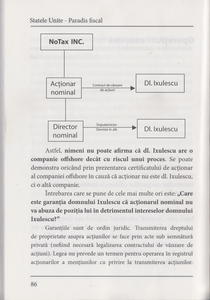
SCHEME1
Foto: OCCRP
Astfel, nimeni nu poate afirma ca dl. Ixulescu are o companie offshore decat cu riscul unui proces. Se poate demonstra oricand prin prezentarea certificatului de actionar al companiei offshore in cauza, ca actionar nu este dl. Ixulescu ci o alta companie.
Intrebarea care se pune de cele mai multe ori este: "Care este garantia domnului Ixulescu ca actionarul nominal nu va abuza de pozitia lui in detrumentul intereselor domnului Ixulescu?"
Garantiile sunt de ordin juridic. Transmiterea dreptului de proprietate asupra actiunilor se face prin acte de semnatura privata (nefiind necesara legalizarea contractului de actiuni). Legea nu prevede un termen pentru operarea in registrul actionarilor a mentiunilor cu privire la transmiterea actiunilor. Astfel, stand lucrurile, actionarul nominal va remite un contract de vanzare a actiunilor companiei domnului Ixulescu. Acest document este semnat de <vanzator> (de actionarul nominal), dar nu este datat.
Prin simpla datare, dl.Ixulescu poate deveni oricand actionarul companiei. Documentul se poate, bineinteles, antedata. Contractul de vanzare de actiuni dintre actionarul nominal si beficiarul adevarat al companiei este un document intern, nedisponibil ochiului curios al tertilor.
De multe ori, actionarul nominal este dublat si de un director nominal. Dupa cum in prealabil banuiti, directorul nominal este o persoana fizica care apare in actele constitutive ale companiei offshore, avand rolul de a-l acoperi pe adevaratul director (dl. Ixulescu) al companiei.
Exista doua moduri prin care dl. Ixulescu poate controla de la "distanta" compania, in conditii de anonimitate:
Primul este sa solicite de la directorul nominal o procura generala prin care este imputernicit sa exercite toate drepturile pe care le-ar fi avut daca ar fi fost director. Astfel, dl. Ixulescu se va putea comporta ca si directorul companiei, fara sa fie insa trecut in actele companiei offshore ca director. Poate cineva sa spuna ca dl. Ixulescu este directorul companiei offshore? Nu! Directorul este altcineva, dovada fiind actele constitutive ale companiei in care altcineva apare ca fiind detinatorul functiei de director.
Exista si un alt mecanism, cu un grad mai ridicat de protectie a identitatii adevaratului director (beneficiar) al companiei offshore. In acest caz, directorul nominal (persoana fizica straina sau un consultant profesionist din Romania), va primi indicatii precise de la dl. Ixulescu cu privire la actele pe care sa le savarseasca functionarul nominal in numele companiei. Directorul nominal va semna (la indicatiile domnului Ixulescu) contractele societatii offshore, va putea sa semneze chiar si in banci, va putea da ordine brokerilor, poate semna acte constitutive ale unor firme romanesti unde compania offshore va deveni asociat etc. Acest din urma mecanism are, insa, un mare dezavantaj, si anume costul ridicat al serviciilor directorului nominal.
In cazul utilizarii directorului nominal, garantia impotriva abuzului acestuia in detrimentul drepturilor adevaratului beneficiar al companiei (dl. Ixulescu) este demisia in alb (nedatata). Astfel, directorul poate fi demis chiar si retroactiv, anuland toate actele efectuate de director dupa data trecuta pe demisie. Acestea devin nule pentru ca directorul a actionat in afara competentelor (nu a mai fost director).
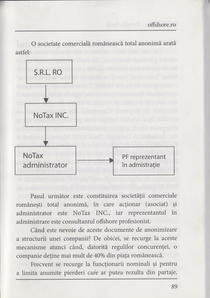
SCHEME2
Foto: OCCRP
Cand este nevoie de aceste documente de anonimizare a structurii acestei companii? De obicei, se recurge la aceste mecanisme atunci cand, datorita regulilor concurentei, o companie detine mai mult de 40% din piata romaneasca.
Frecvent, se recurge la functionarii nominali si pentru a limita anumite pierderi care ar putea rezulta din partaje, falimente si asa mai departe.
Dar cea mai mare valoare o are anonimizarea atunci cand o persoana doreste ca, din varii motive, numele sau sa nu fi asociat cu o anumita afacere pe care vrea s-o deruleze. Orice <binevoitor> care il va cauta pe dracu' va da de tata-su¬, cum spune zicala din batrani. Orice declaratie publica in care numele domnului Ixulescu este legat de firma romaneasca sau de afacerile derulate de aceasta se izbeste de proba contrarie furnizata de Registrul Comertului din Romania, care va certifica lipsa oricarei legaturi intre persoana domniei sale si afacerea in cauza, actionar si administrator fiind firma NoTax Inc. cu sediul in Delaware. Daca totusi, bagaretul persista si clameaza o eventuala legatura intre dl. Ixulescu si firma NoTax Inc. din Delaware, se intra intr-o chestiune si mai delicata, deoarece nimeni nu poate aduce dovezi in acest sens. Iar daca in urma acestor demersuri, dl. Ixulescu se simte lezat, urmeaza un proces de calomnie implacabil intentat <binevoitorului>.
In genere, subiectul anonimizarii depline este destul de sensibil si are o aplicabilitate diferita de la speta la speta."
In prezent, Kiss are ocazia sa-si verifice personal propriul sistem. Dupa arestarea cosultantului, procurorii au sustinut in fata judecatorului ca Kiss Laszlo Gyorgy se afla in spatele unui numar de companii offshore platite cu bani grei pentru servicii de consultanta fictive. Kiss a negat acuzatia si a cerut instantei sa fie eliberat pe motiv ca nu are nici o responsabilitate in afacerile offshore. Curtea i-a respins cererea, iar Kiss a ramas dupa gratii.
Cum sa-ti ascunzi averea pana si de sotie
Dincolo de avantajele offshore specifice in Delaware, Kiss Laszlo Gyorgy conteaza si pe faptul ca statul american nu are notorietate de paradis fiscal, asa cum au, de pilda, Insulele Virgine Britanice sau Cayman. Efectul e previzibil: pentru neavizati, un IBC american poate avea aceeasi onorabilitate in piata ca orice alta firma normala din Statele Unite.
Este unul dintre motivele pentru care Kiss recomanda calduros dismularea averilor personale, dar si a activelor din afacerile colaterale, printr-un offshore din Delaware. Daca in cazul activelor este vorba de o inginerie financiara cu scopul de a le feri de executare, litigii sau faliment, in contextul proprietatilor personale, retorica lui Kiss iese din comun. In cartea sa, consultantul offshore compara divort unui anume K.L. (initialele sale - n.n.) cu cel al magnatului Donald Trump si isi felicita "personajul" pentru inspiratia avuta cand a pacalit Justitia romana la pachet cu fosta nevasta. In contrapartida, Kiss il deplange pe miliardarul american, "mai putin inspirat" decat el.
Pasajul din "United States, Tax Heaven - Uncle Sam Will Fight Your Taxes!" este ilustrativ:
"Cine nu a auzit de Ivana Trump si de metodele ei diabolice de jecmanire in instanta a averii sotului la divort? Este inutil sa precizam de partea cui este Justitia in noua cazuri din zece (si asta ca sa fim generosi)...
Se poate face ceva? Justitia spune ca nu. Si noi ii dam dreptate, din punctul ei de vedere, pentru ca scopul nostru nu este sa ne punem impotriva Justitiei. Ce nu vede doamna legata la ochi este scurtatura care te pune la adapost de orice neplaceri.
Sa luam un exemplu din viata reala. Si nu din America, ci din Romania. Este poveste lui K.L., (Kiss Laszlo - n.n.) unul dintre fondatorii firmei de consultanta http://www.offshore.ro/. (site-ul Lamark Tax Planning Consult SRL - n.n). Atunci cand K.L. a inceput sa faca afaceri pe cont propriu, muncind 18 ore pe zi, sumele din conturile sale au inceput sa creasca. Din ce in ce mai mult.
Ceea ce am uitat sa va spunem este ca dl. K.L. era foarte tanar, casatorit si fericit in casnicie. Timpul a trecut, iubirea a murit putin cate putin, si a venit momentul divortului. Si al partajului. S-a impartit numai ceea ce aparea ca apartinand lui K.L. Adica, mai nimic.
Norocul lui a fost ca toate investitiile le-a facut prin intermediul unui vehicul special: o companie din Delaware. A administrat apartamente de bloc in numele si pe seama acestei companii. A deschis conturi de investitii la firme de brokeraj si a cumparat titluri de valoare in numele si pe seama acestei companii.
Cine era fericitul proprietar al acestor apartamente si al pachetelor de acte? Era K.L.? Nici vorba! K.L. nu avea nimic, nu figura in nicio foaie de avere imobiliara ca fiind proprietar al acestor apartamente. Proprietar al acestor bunuri era compania offshore din Delaware.
Cine era beneficiarul acestor companii? Doar bunul Dumnezeu si K.L. stiau. Tot ceea ce a fost obtinut de compania din Delaware a ramas la adapost de ciocanul judecatorului.
Vi se pare cinic? Atunci, va sfatuim sa-l contactati pe Donald Trump. Pariem un Mercedes contra unei trotinete ca o sa va spuna ca se va cai toata viata ca nu a avut inspiratia sa procedeze ca domnul K.L. (...) Acum este tarziu pentru el. Si pentru multi altii..."
Pe de alta parte exista agenti registrari care promoveaza jurisdictia Delaware doar ca si masura legala de optimizare fiscala, Frank Dosebio reprezentant al unei companii de profil localizata chiar in Delaware U.S declara ca prin intermediul companiei reprezentate de el , in speta Evedex Inc http://www.evedex.net/,. anual se inregistreaza in Divizia Corporatiilor Delaware aproximativ 800 de companii de tip LLC si 200 de Corporatii , majoritatea acestor firme fiind constituite de catre nerezidenti US, in scopul de a beneficia de avantajele fiscale unice oferite de statul Delaware, masura detinerii si folosirii a unei astfel de companii fiind perfect legala atata vreme cat se respecta legislatia jurisdictiei de incorporare.
"Nu acceptam pentru incorporare, companii care au ca obiect de activitate prestarea serviciilor de orice fel cu continut adult-enterteiment, chat, video-chat sau orice alt servciu dedicat exclusiv adultilor, inclusiv administrarea site-urilor web cu un astfel de caracter, de asemenea exista restrictii ce impun o licentiere suplimentara obligatorie pentru organizarea de loterii, jocuri de noroc, tombole, activitati specifice casinourilor, chiar si daca vorbim de activitati prestate online. Incepand cu luna iunie 2010, Evedex nu incorporeaza companii LLC fondate de catre membri rezidenti in unul din statele: Afganistan, Iran, Irak decat cu repectarea in totalitate a prevederilor Patriot Act"
Frank Dosebio confirma insa ca toate aceste companii fondate in Delaware, beneficiaza de o anonimitate totala, fiind realmente imposibil ca agentul registrat sau Divizia Corporatiilor sa furnizeze tertilor orice date cu privire identitatea beneficiarilor reali (n.r: directori/asociati) , existand in acest sens reglementari stricte care fac din aceste companii inregistrate in Delaware adevarate "fortarete" in fata oricarei persoane interesate in aflarea actionariatului firmei.
Ca si concluzie, optimizarea fiscala nu trebuie confundata cu practicile evazioniste descrise de infractori dovediti de instanta precum Kiss Laszlo , ci trebuie facuta in limita bunului simt, mai ales ca apeland la jurisdictia corecta avantajele pot fi cat se poate de evidente..si legale.
joi, 19 iulie 2012
Features of Delaware Corporations
Features of Delaware Corporations
FeaturesComparison
More Information
The company (entity type) our clients select when raising capital from the public or Venture Capitalists is the General Corporation. Here are some features of the Delaware General Corporation (C-Corporation):
Reporting
- A Delaware Corporation may file a Certificate of Incorporation which does not name the Initial Director.
- A Delaware Corporation is required to file an Annual Report which must include:
- The phone number and address of the business
- The name and address of one officer
- The names and addresses of all Directors
- The shareholders are not listed on the annual report and are not reported to the state.
Income Tax
- There is no Delaware state corporate income tax on goods or services provided by Delaware Corporations operating outside of Delaware.
- There is no Delaware Sales Tax.
- Tax Status:
- The default tax status is C-Corporation. The C-Corporation pays income tax at corporate rates and files a corporate income tax return.
- If eligible, the corporation may elect S-Corporation tax status. An S-Corporation is taxed at personal income tax rates and the profits and losses are reported on the personal income tax return.
- If organized as a not-for-profit corporation, the company can apply for tax-exempt status from the IRS.
For more information about tax status see the Corporations section of the Delaware Incorporation Handbook.
Liability
- The liability of all shareholders (owners) is limited to their investments in the corporation (unless they personally guarantee other debt incurred by the corporation, commit fraud or commingle funds).
Compliance
- A Delaware Corporation is required by law to maintain a Registered Agent in the state of in the state of Delaware. DBI will be your Delaware Registered Agent and the first 12 months of Registered Agent service is free with the purchase of a New Company Registration Package. The service is $100/year thereafter ($120 outside the US).
- A Corporation authorizing 5,000 shares or less will pay the minimum Franchise Tax of $75 plus a $50 Annual Report Filing Fee.
- A Delaware corporation has the right to conduct Interstate Business and DBI can qualify a Delaware corporation to conduct Intrastate Business; please see the article on Qualification.
International
- Non-resident, Non-citizens are eligible to form a C-Corporation or a Not-for-Profit organization in Delaware. Non-residents are not eligible to apply for S-Corporation tax status. Please see our section for international businesses.
- A Delaware Corporation with no US Source Income will not owe US Federal Income Tax.
Investment
- A Corporation can raise capital by selling shares of stock privately or on a public stock exchange.
- Ownership of a Corporation is recorded on stock certificates.
Abonați-vă la:
Postări (Atom)